

Death Practice
or concerning meditation and rivers...

There is a meditation technique that is offered by various teachers informed by various philosophies — religious, secular, and esoteric. Using different words and embedding the technique in their own individual contexts, these teachers ultimately point at the same kernel of practice by inviting the meditator to focus on the out breath.
You can try it now, very simply and informally. Just notice, when your next exhale happens, what that moment feels like. Does it feel like release? Relief? Does it feel like something is leaving you, while you remain behind? Does it feel like you yourself go out, on the breath? If so, do you go out in one direction, riding the breath like a wave? Or do you spread out in all directions, dissolving, with the breath, into the air?
Now notice what the next few moments feel like. The ones before your body reflexively breathes in again. Don’t resist the inhale, but don’t rush it, either. Trust that your lungs and diaphragm will call the air back when they need it, just as they do all night long, when you sleep. Knowing that there’s nothing you have to do, in this space, that your body will take care of itself, notice how it feels to be between breaths. Is there tension? A sense of floating? Disorientation? Anxiety? Relaxation?
When you inhale, again, allow that inhale to be the work of the body. Try to let your consciousness skip over that moment, that inhale, to focus on the next exhale, and the next. What can happen is that the moments of focus on that space between one exhale and the next string themselves together, like pearls, then eventually blur together so that your mind rests consistently in that experience of in-between.
Some people find that experience to be vast, spacious, even liberating. Some find it groundless and frightening. There can be a sense of rising, or of falling. Of an expansion or a narrowing of attention. Some people report sensing more light, around them, in that space. Some feel as though the light around them is dimming.
Like most meditation techniques, the invitation extended here is to direct experience. There is no inherent meaning. How this space feels, to you, doesn’t necessarily tell you anything about yourself. At the same time, there is always an opportunity to learn about ourselves, about the ways our minds and bodies work and often work together, by observing our reaction to direct experience. Our bodies react in physical ways: Muscles tighten or relax, respiration speeds up or slows down, we sweat maybe, or shiver. The reaction of the mind manifests most often in emotion and cognition. We tell a story about the experience, we assign meaning to it, and we feel emotions prompted by that narrative.
One way I like to work with this meditation technique is to assign a particular meaning to it, ahead of time. I invite myself (and you) to understand the space between exhale and inhale as a doorway between Life and Death.
With this understanding, I enter into the meditation with the express purpose of exploring that space, watching my reactions there, and becoming familiar with (maybe even comfortable with?) a place I will, someday, go.
I exhale. If I don’t inhale again, I die. The moment of death, at least as observed by those who are witnessing it, is always this simple. There is, finally, an exhale that is not followed by an inhale. Time stretches out. We watch, breathless ourselves, for the chest to rise, again. It does not. The possibility, that has been teetering on a tightrope strung between one breath and another, slowly becomes a probability, then a certainty. Death has occurred. We breathe, again. The person who is dead, does not. For a moment, this is the only and the enormous difference between the two of us. It is a moment of the most profoundly shared experience of humanity - mortality. And it is a moment of dawning, immense, irrevocable difference. Whatever this line is, that seems drawn between those of us who breathe, and those who don’t, we are on opposite sides of it, now.
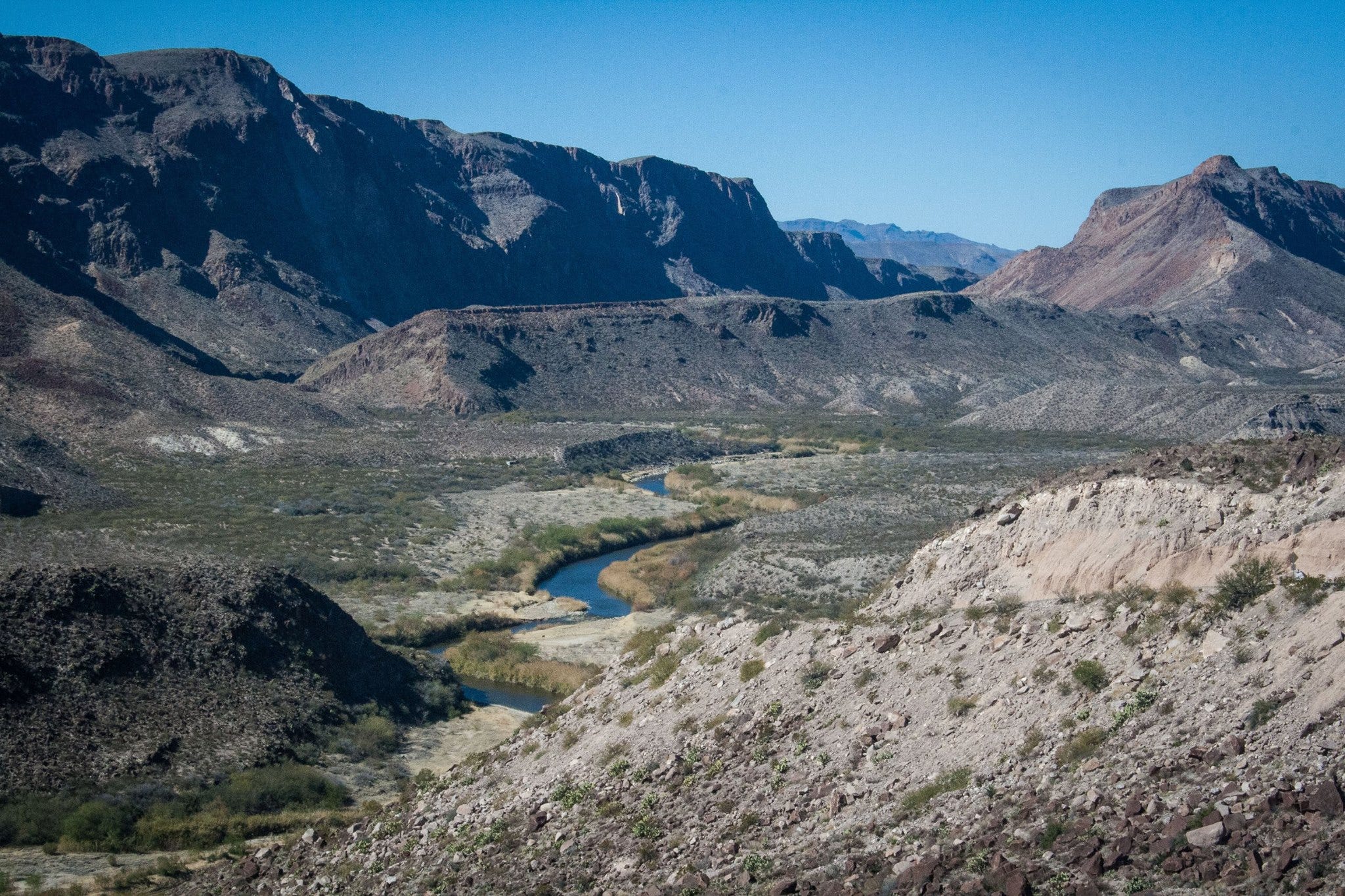
The first time I saw the Rio Grande was in the Big Bend area of southwest Texas. Living in the south of that state, as I had then for many years, I’d heard stories about the dangerous crossing of that body of water, undertaken by people so desperate for a better life that they left all they knew and loved, and braved the currents and depths of the Big River, hoping to reach the other side. But the river I saw was, in that place, just a stream. Knee-high. Something to wade across in five steps or so. Families, in that place, had lived on both sides of the border for centuries, moving back and forth easily before lines were drawn, arbitrarily, and enforced senselessly. A farmer whose goat wanders across the shallow water to graze on the other side can’t simply follow the beast and bring him back. That farmer has to travel miles up or downriver to the nearest sanctioned crossing, and present papers, just to have the chance of finding his goat again, miles away, in another country, and bringing him home the same long, laborious way.
When I do this meditation, I often see, in my mind’s eye, this stretch of the Rio Grande. The simplicity of the crossing. And, at the same time, the enormous import of that crossing. I see our medical industry, for all of its best intentions, as the gatekeepers at those sanctioned crossing places, imagining that they are mediating the journey from one side to another. I see politicians imagining that the line they’ve drawn in the middle of that river, that exists only in their minds and on their maps, means anything at all to the beings who live on either side of it.
What if the experience of death, I wonder, is as simple as stepping across a narrow spot in that river? What if that’s the revelation that awaits us after a lifetime of being told that the river is wide, raging, treacherous and terrifying?
Of course, I don’t know. I can’t know. And, as best I can tell, when I do know, I won’t be able to tell you. But this is why I practice. I find, and notice, the thin places. I seek out and explore liminality. I think those between spaces have something to teach me about all transitions, and so help me live with more equanimity even before I face the Big Kahuna (or so we all seem to think) of all transitions, Death.
I rehearse my own death, a little, every time I do these practices. And, at this point in my life, that seems like useful, even necessary work.